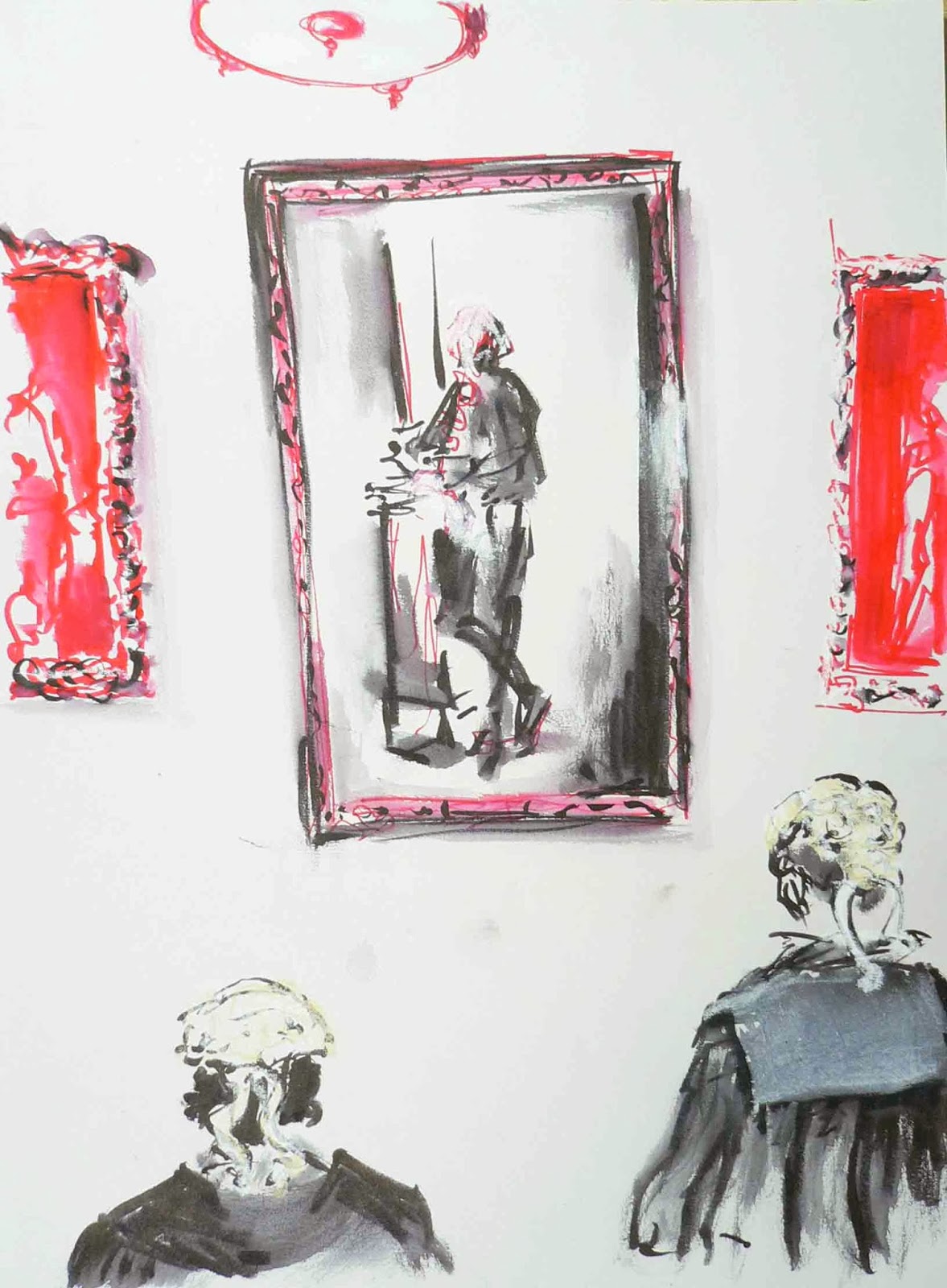
Friday, 31 January 2014

Conference: 'Performing the law: the effective v the virtual'

This comes to you in hallucinatory snatches as I enact an operatic deathbed scene with mansize tissues, aka the common cold.

We're at the Institut français in South Kensington for an anglo-French-American conference. Academics, lawyers, artists, actors.

The key word is 'performative'. To what extent do lawyers, and the law itself, perform? Asking this question is all the rage.

'Being Wallander is very much an existentialist state.' The perfect sequel to Hamlet for Kenneth Branagh, then.

'What is the function of seduction in these TV crime dramas? Are they akin to sexuality and parenting?'
'Do they educate or obfuscate?'

'One wants to make work in the form of a virus.'


'You cannot represent the boredom of boredom.'
'You have to look to Chekhov for how to do it.'

'If you're complaining about a dog that barks in the night, make sure the judge doesn't have a dog that barks.'

'There are locked courtrooms which haven't been used for years - it's a perfect metaphor for Belgium.'

'Sometimes in court lawyers are so small you don't see them.'


This is not my drawing [left]. It's by someone with a decent line. The ultimate drawing of the effects of legal process: Marie-Antoinette on her way to the guillotine, sketched by Jacques-Louis David. He voted for her execution. Her trial was re-enacted verbatim on stage in the USA: audiences on most nights, not needing a sense of history, let her live.

More pictures if you scroll down.


Wednesday, 29 January 2014

Supreme Court art: risky credit


So he went into PC World and...

You can hold it there. That already makes me feel like Ruth weeping amid the alien corn. But back to Durkin v DSG Retail Ltd and HFC Bank Plc.

...into PC World in 1998 and asked if the laptop had a built-in modem.

'Yes, it does.'

He bought it on the understanding that he could return it if it didn't have a built-in modem, paid a £50 deposit and signed a consumer credit agreement to cover the balance.

The laptop did not have a built-in modem. And the credit agreement had small print. 

The salesperson, having triggered 16 years of costly litigation, vanished from the story. Mr Durkin returned the laptop and felt he should not have to pay for something he no longer owned but his credit rating was trashed.

Today the bench exudes energy, led by a brightly fascinated Lady Hale. Amid discussion of the doctrine of confusio, I meander down memory lane. 

There was the time the London Electricity Board (RIP) broke into my flat, treading dog mess into the floor, and changed the locks because they mistook it for the flat upstairs, leaving me locked out for the night. The time the Nationwide lost the deeds to my flat when I was trying to sell it.


And the time the Royal Bank of Scotland mysteriously changed the payee for my mortgage standing order. Month after month I unknowingly drew closer to eviction. When I got a danger signal from my mortgagee, I rang someone at RBS. 'We were wondering when you'd get in touch,' he sniggered, as if I'd been the subject of a bet.  

None of these is analogous to the credit agreement issue. But I am lamenting those modem moments we all share, which could be avoided if someone gave a toss.

In court today, a tourist couple shove me half off the end of the bench by plonking themselves down in a space meant for one. As I try not to fall off my precarious perch I think of the Nationwide some decades ago, refusing me a mortgage on the stated grounds that I was a single woman, not a couple.

'I am financially entitled to a mortgage,' I snapped.
'But ethically?' he sneered.

Children, that's the way things were. I was not a bad debt, but a morally undeserving one at a time when mortgages and credit agreements were not being thrust at consumers.


Coda:

Every time I pass a branch of PC World, Pavlovian conditioning evokes a scene from The West Wing in which CJ warns an erring colleague: 'I'm going to shove a motherboard so far up your ass.'

Today hasn't helped.

More pictures if you scroll down.


Thursday, 16 January 2014

Supreme Court art: dress codes


Call me reactionary but I like a well-designed uniform.

What better to suppress merely personal opinions and to preserve the sober anonymity of statute than an outfit rooted in seventeenth century court dress, which suits both men and women.

Before you say it's OK for me, I don't have to wear a wig, I would draw your attention to the hair extensions I saw in court today. What's that about, apart from pain?

Court 3 itself has a wig, in a way. The fixed carpet in front of the bench bears the emblem of the Supreme Court - but put another rug on top and voilà, you've got the Judicial Committee of the Privy Council, which hears appeals from the UK overseas territories, Crown dependencies and some Commonwealth countries.


To see which statutes are in play, look for the flag: Isle of Man today.

The information sheet says that Holt v Her Majesty's Attorney General on behalf of the Queen will examine 'money laundering - falsification of documents - misdirection of jury - improper comments made by trial judge - whether miscarriage of justice - whether conviction unsafe.' It's not an edifying tale. People took certain precautions 'in case we **** up'. They did. I have a pang of regret that I'm not in Court 2 (village greens).

So back to court costume and an irresistible, entertaining, erudite book: Dress, Law and Naked Truth by Gary Watt (Bloomsbury, 2013).

Hogarth liked to bait the legal profession, as in his engraving The Five Orders of Periwigs. 'Aping the standard scheme drawings of architectural orders,' writes Professor Watt, '...Hogarth shows the judicial periwig [third row down] overlaid with lines to indicate the rules that determine the relative proportions of its parts.'

Steeped in Gillray, I've always taken this engraving to be not just a parody but obscene, although no one else seems to mention that, unless I've missed something.

And if you think I'm frivolous, may I refer you to the Cour de cassation, the French equivalent of the Supreme Court:


As I leave the court I see a confetti star glinting on the wet pavement.

A bemused security guard asks me what I'm photographing (the guards here are as genial as you could wish).

I garble this quotation from a forgotten versifier:

'Two men look out through the same bars:
One sees the mud, and one the stars.' 

'Look, there's another one,' says the guard. 

My blogger uniform looks rather arch and twee today. It might not be appreciated by anyone whose liberty is at stake.

More pictures if you scroll down.


Friday, 27 December 2013

If it's Christmas, it's Crisis

Let's start with the small print: the guests signed Crisis consent forms to release these pictures.

So. Dickens would have tried to make you weep if he'd seen Crisis in operation.

But there's no time for Mr Popular Sentiment. If you drop your guard and glimpse the enormity, the appalling insolubility of the underlying problem, or if the red rage coshes you from behind, do something constructive. Be a manicurist, make up the numbers for ping pong, unload food supplies, look after a rough sleeper's dog, give someone your undivided attention, sing.

Don't get dehydrated, don't let your blood sugar sink. Here, have a Quality Street. No, I don't know what flavour it is. Forget choice. The only reality is here, where any stray sparks of discord are quickly dampened by firm kindness and tolerance.

I'm at the West London Day Centre, the Downton Abbey of Crisis. There are tougher gigs.

We all know the chorus. There's no room for cynicism. You'll find camaraderie, instant life stories, jokes, hope.


'Put the date on this picture please. I don't intend to be here next year.'

'How long do you sleep at night? For me it's five foot ten.'

'Do you draw before you go to bed? I do. I draw the curtains.'

'Oh, don't do his picture. He thinks he's good looking enough already. He'll stick it on the wall and pray to it.'

A softly spoken guest, courteous and deferential, has a personality change at karaoke time. He knocks out I like the way you move by the Body Rockers. Cue tumultuous applause. Then he goes quietly off to the canteen on his own.

Make sure guests know what services are on offer. Would you like a shower? Game of football? Language tuition? Advice on housing or addiction? Sewing repairs to your clothes or bags? Do you just want to spend the afternoon asleep, safe, warm, dry, fed? Surrounded by scruffy and unfussy volunteers? 

I said unfussy. At this time of year I park all the crap outside - it's a relief, frankly.


The drawings here show yoga, exercise classes, the art and craft room, the hair and nail salon, karaoke. I give each drawing to the sitter as a rule, but I've kept some of the group pictures.

It's The Wizard of Oz on TV.

A guest grabs the mike and sings that Boney M song.

By the rivers of Babylon, there we sat down, yea, we wept, when we remembered Zion.

She goes around showing the drawing to people. 'Look at this.'

It is herself.

Please scroll down for more images.


Tuesday, 17 December 2013

Uneaseful death

For with my own eyes I saw the Sibyl at Cumae hanging in a jar, and when the boys asked her, 'Sibyl, what do you want?' she replied, 'I want to die.' (Petronius, Satyricon)

But she couldn't.

As the price for her virginity, the Sibyl had asked Apollo for as many years of life as the grains of sand she could hold. But she rejected him and he punished her. She had forgotten to ask for continuing youth and beauty. Over a thousand years she dwindled to nothing more than a voice.


Doctors can dish out what feels like immortality when we don’t want it. If we're fit enough to get to a cliff top, we can jump. For some, there’s a ghastly trip to that Swiss clinic. But if we can't make even that journey, what then?

I thought today’s hearing, about assisted suicide, might be unbearable but the courtroom formality anaesthetises emotions to an extent. It’s tense though. Before the start, a barrister confesses to a court official: ‘I’ve already knocked over one of those jugs.’

Nine justices are hearing R (on the application of Nicklinson and another) v Ministry of Justice.
It’s too late for Tony Nicklinson whose widow Jane (above, centre) is in the public seats.

There’s a bit of bother with rogue mobile phones but the packed court is silently intent when counsel talks about cruel modes of death which near-helpless people have chosen because something kinder is against the law. Drowning. Asphyxiation. Dehydration.


At lunchtime the neighbours come to the foyer to sing carols: the Treasury Singers are raising money for Crisis. The holly bears a berry as red as any blood, as sharp as any thorn, as bitter as any gall. The law’s prevailing view about the right to assisted suicide is a Christian one. For discussion today is an unholy stew of human rights, the Suicide Act 1961, compassion, morals. What’s Parliament going to do? ‘There are some inactions by the legislature which are effectively decisions,’ says the bench today.

After the hearing I make my way through the dark streets. Strong healthy people step out in front of cars without looking, as usual. I meet a friend who’s a GP. I hope he'll be around if I need him for something terminal. No chance, he says. Not after Harold Shipman.


In The Savage God A. Alvarez writes that the American poet Robert Lowell 'once remarked that if there were some little switch in the arm which one could press in order to die immediately and without pain, then everyone would sooner or later commit suicide.'


River Landscape with Apollo and the Cumaean Sibyl
Salvator Rosa, Wallace Collection