Showing posts with label Read Not Dead. Show all posts

Thursday, 22 November 2018

Read Not Dead: proving that old plays aren't basket cases

Here are some Brexit campaigners with a hamper of tombola prizes designed to show Michel Barnier that the UK is primed to dominate world markets. Co-opted to their cause is Shakespeare, who plundered European sources for a living. Post-Brexit, Shakespeare will still be exploited for national morale and soft power, despite the damage which a dented economy and lack of free movement will do to the arts in the UK. 

At least Shakespeare doesn't have to carry the whole weight of Brexiters' expectations: he didn't work in a vacuum. For example, doomed resentment, so palpable in the photograph above, drives the anti-hero of The Tragedy of Sir John Van Olden Barnavelt by John Fletcher and Philip Massinger. Performed on 18 November in the Sam Wanamaker Playhouse, this is one of some 400 early modern plays which Shakespeare's Globe's Read Not Dead team brings to life. 

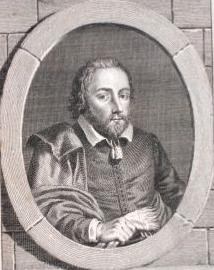
Philip Massinger
With minimal preparation the uncut plays are performed script-in-hand. There are laughs but, for anyone who saw Peter Brook's 1970 RSC white box production of A Midsummer Night's Dream, the raw exposure of the Read Not Dead experience evokes his interpretation of the rude mechanicals' play-within-the-play: this was not the usual Carry-On diversion but a devotional uncovering of the mystery of performance.

Meanwhile the A4 printed scripts take on a life of their own. Can you memorise the odd line and look up - a risk which Tim Frances, triumphant in the title role, got away with? And what about props? With all the page-turning, you can end up waving a pistol like a biro in your spare hand. 

John Fletcher
But when Oliver Senton as Leidenberch, kneeling at the front of the stage, read out his final speech while stabbing himself with a dagger, it was too real for me to watch, and not just because of his performance: there was something terrifying about the script on the floor in front of him, a metaphor for compulsion and inevitability. 

The absence of stage blood - the obvious artifice of which cauterises emotion, to my mind - was another dramatic advantage. (Don't tell me, some people faint at the sight of the fake stuff, I know.) 

I was however able to watch the stylised, slow-motion beheading (for treason) of Sir John: the sword, safely away from his bowed head, preserved tension while severing his connection with the audience so that he could leave the stage, job done.

Portrait by Michiel Jansz van Mierevelt
The Dutch statesman Johan van Oldenbarnevelt was an historic figure. His nemesis, the Prince of Orange, was played with smooth authority by Alan Cox in this reading. Political and religious intrigues in this hastily-written play echoed divisions at home, so the work was censored before its first performance in 1619, the year of Johan's execution. This revival, directed by James Wallace and including Dan Abelson, James Askill, Rhys Bevan, Adam Cunis, Emma Denly, Georgia Frost, Frances Marshall, David Meyer, Mark Oosterveen, Mark Springer, James Thorne and Leo Wan, was the last in Read Not Dead's season about censorship.

For an image to represent the canon of early modern plays waiting to be aired, I give you the chewing gum patches on the Millennium Bridge outside the Globe. These are regularly embellished by Ben Wilson, the Chewing Gum Artist. As one painted patch fades with the passage of years and footprints, he illuminates another, depicting lives of passers-by from around the world. If you see Ben at work, talk to him for the sake of his humane philosophy.


Monday, 29 October 2018

Pro-amdram at Gray's Inn

The interval
The poet Ruth Padel, allowed to study one of Beethoven's manuscripts, kissed it when the curator wasn't looking. This self-dramatising act of microbial vandalism is enough to make archivists faint, even if she wasn't wearing lipstick. By contrast, the Globe Theatre is more positively engaged in an archival kiss of life: its Read Not Dead programme resuscitates the 400-odd early modern plays languishing in the attic.

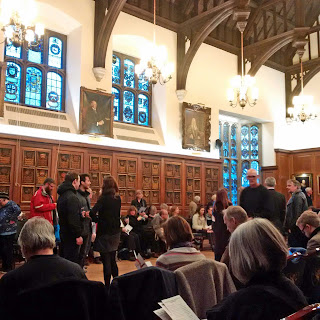
The simplest way to unleash these is to have a script-in-hand, wear-your-own-clothes, move-dynamically-around-the-space-not-bumping-into-each-other reading. Once a year Read Not Dead serves an intriguing cocktail of legal amateur thesps versus real ones in Gray's Inn Hall. This year it was The Little French Lawyer by John Fletcher and Philip Massinger, a polemic against the vice of duelling, directed (briefly) by Nick Hutchison.

John Fletcher
First performed in 1619-23, it has some modern resonances. To start with it is dismally Brexity - dissing the French and other foreigners. In wondering how to treat his wife, a husband points out:
'...I am no Italian
To lock her up; nor would I be a Dutchman,
To have my Wife, my soveraign, to command me...'

It is also very #MeToo, with threats of rape and murder lightly dismissed in a 'happy' ending, and a jolly plot device which allows a strange man to invade the bed of a 16-year-old virgin but that's fine, she's cool with it of course.

Philip Massinger

The attraction of these fleet-footed performances - which have a fiercely loyal following - is that they highlight the actors' skill, vulnerability and risk-taking, without the distractions (which can be ponderous) of costume, lighting, sets, music, make-up, props and, most importantly, the inescapable clamp of the director's world view which may or may not be to your liking.

It was not hard to distinguish the actors from the lawyers. Barristers focus on a small audience: the bench and, if present, the jury. Emotion is cauterised by court procedure. They deliver from one spot. Insults exchanged between bench and counsel are normally so subtle as to be imperceptible to the lay person. Melodrama is rare. William Clegg QC may have fallen from his chair in the 'phone hacking trial but that was not grandstanding to the jury. In court, containment has more effect than histrionics - as in the calm, measured presentation of harrowing facts in In the matter of an application by the Northern Ireland Human Rights Commission for Judicial Review about abortion, heard in the UK Supreme Court last year.

The Globe actors provided the superstructure. Philip Bird kept the play together and gave some charm to the psychopathic anti-hero Dinant. Eliza Butterworth was zestful and winning as the heroine, Lamira. William Foote, Emily Houghton, Rosalind Lailey, Charlotte Newton-John, Patrick Osborne, Doug Rao and Jay Varsani made it look easy when it wasn't.

For Gray's Inn, the distinguished Sir Michael Burton, who in addition to his many legal achievements is a grandfather of nine, was dashing and appealing as the loyal Lamira's one-armed, one-legged husband in the May-and-December romance at the centre of the play. This will not resonate with many still living, but something in the timbre of his voice took me back to Toytown on Children's Hour (broadcast on the Home Service) and the character of Mr Growser ('This is disgrrrrrrrraceful - it ought not to be allowed'). Enthusiastic forensic support was provided by Master Roger Eastman, Gillian Geddes, Colin Manning, Josie Teale, and Sandra Villani (of Venters Solicitors).

Presiding over all was a portrait of Lord Atkin, immortalised by Donoghue v Stevenson, a case as dramatic and yet inconclusive (was there a snail in the ginger beer?) as this Jacobean comedy.

Monday, 17 September 2018

Read Not Dead: 'The Queen's Arcadia' returns to Christ Church, Oxford

As cover versions go, Verdi's Falstaff (libretto by Boito) has the edge on Shakespeare's The Merry Wives of Windsor, knocked out to gratify the whim of Queen Elizabeth I. The RSC's current production is indebted to Barbara Windsor, Benny Hill, and the triumph of Essex (not the Earl) on reality TV. The cast go hell for leather and don't bother to mine it for Lear-like pathos. Costumes are a clever blingy mock-Tudor. There is a cute toy dog. I'm pleased to see they are recycling the throne from their last history cycle.

What can Read Not Dead, Globe Education's Leverhulme-funded early-modern resuscitation team, do with a less performable text? Samuel Daniel's The Queen's Arcadia, another play written for royalty (King James I's consort, Queen Anne of Denmark), was first performed in the blurry acoustic of Christ Church hall, Oxford, in 1605.

Think Love Island without the profondeur. There are lovelorn nymphs and shepherds (one suicidal), slick poetry by the yard and a section about the evils of smoking designed to flatter King James I, author of A Counterblaste to Tobacco.

One day you're Dean of Christ Church, next you're so much lumber


On a CPR course I was mortified to break five ribs on the dummy but the trainer shrugged... And Read Not Dead's bone-cracking techniques are what's needed to keep the patient alive. They scamper through the text before the public performance, then they read for their lives, moving as much as they can in limited territory, improvising to get out of scrapes, galvanised by currents of mutual support. Their risk-taking provides the drama when the text sags.

All the cast had the enlivening qualities the loyal Read Not Dead audience expect: I particularly liked David Collins and Colin Blumenau as the 'ancient Arcadians' propping up idealism, John Hopkins and Sid Sagar making the best of the stock 'funny' doctor and lawyer, and Ross O'Donnellan for a breath of fresh air and cute-toy-dog-handling skills as the shepherd Carinus. The programme note makes a brave attempt at spelling dastardly ('darstedly').

Prop dog politely ignores bread on floor
Also in 1605, away from theatricals, seething religious divisions built up to the gunpowder plot. Nowadays the country is riven by the disastrous cult of Brexit. Christ Church has provided more British prime ministers than any other tertiary institution so, in hall, portraits of Eden, Gladstone, Douglas-Home, Lord Salisbury and others too numerous to mention look down on the political shambles. The sunlight hitting the glass over the paintings picks out over-generous traces of cleaning product, perhaps Windolene, applied vigorously by someone right-handed.

Nothing catches my heart more today than seeing shepherd's purse in the pavement opposite Worcester College:


Here's my sheep-crook and my black dog, I give it to you.
Here's my bottle and my budget, I bid it adieu.
Here's my sheep-crook and my black dog, I leave them behind.
Fine laurel, fine floral, you've proved all unkind...
 

- From Sheep-crook and Black Dog, English folk song

Tuesday, 15 May 2018

Play first aid: 'Eastward Ho!' at Shakespeare's Globe

King James I, Mytens, National Portrait Gallery
A staged playreading, rehearsed in the morning and performed in the afternoon, revives jaded audiences. There's no bother about catching the last train. And without all the clutter, a work that's been dozing for a few hundred years can seem fresh. The cast's energy and the director's ingenuity distract attention from any cobwebs.

Today's resuscitation is part of Read Not Dead, a programme run by the education department at Shakespeare's Globe. In the Sam Wanamaker Playhouse, the cast are slashing their way through jests, japes and bawdy. There hasn't been time to work out all the pronunciations ("manger" versus "manga") but that keeps us on our toes.

Censorship is this year's theme, to commemorate the 50th anniversary of the abolition of theatre censorship in the UK. Eastward Ho!, a parable of one virtuous and one profligate apprentice, satirises London life. Published in 1605, it landed two of its three playwrights in prison for some Scottish jokes which allegedly annoyed King James I. The gags have aged but the old antagonism has been boosted by the divisive horrors of Brexit.

'The Witches' Kitchen' (detail), Francken, Hermitage Museum
We're flying without footnotes but here's meat for costume historians:  

Gertrude: I tell you I cannot endure it; I must be a lady. Do you wear your quoif with a London licket, your stammel petticoat with two guards, the buffin gown with the tuft-taffety cape and the velvet lace. I must be a lady, and I will be a lady. I like some humors of the city dames well: to eat cherries only at an angel a pound, good; to dye rich scarlet black, pretty; to line a grogram gown clean thorough with velvet, tolerable; their pure linen, their smocks of three pounds a smock, are to be borne withal. But your mincing niceries, taffeta pipkins, durance petticoats, and silver bodkins — God's my life, as I shall be a lady, I cannot endure it! — Is he come yet? Lord, what a long knight 't is! — [singing] "And ever she cried, 'Shoot home'!" — And yet I knew one longer. — "And ever she cried, 'Shoot home,' fa, la, ly, re, lo, la!" [In today's reading, a snatch of a song from Grease is substituted here.]
  
A new age brings new associations. Mention of 'an old jealous dotard' conjures up a flicker of Trump, as does a rude song in the original called 'Golden Show'rs', although in this performance it's ditched for a few soulful bars of Wouldn't It Be Loverly from My Fair Lady.

There are no costumes and hardly any props. Who needs them? The river Thames in spate is a sheet of bubble wrap which makes those satisfying bladderwrack pops when trodden on. Given the play's context, a Meghan Markle mask supplies a frisson of treason. (The royal wedding on Saturday is on the anniversary of Anne Boleyn's beheading. No reason for saying that at all.)

All the cast give it welly. I think Michael Matus and Ralph Davis (if the plot is dodgy, drop your trousers) are particularly at home with the challenges of the text but you'd have your own favourites.


Brian Rix and colleagues
Eastward Ho! by George Chapman, Ben Jonson and John Marston was directed by Jason Morell.

Wednesday, 1 November 2017

Read Not Dead: Jacobean tragedy at Gray's Inn


It's suspenseful all right. Will Philip Massinger's neglected Jacobean tragedy, The Unnatural Combat, survive a script-in-hand performance in Gray's Inn Hall? And will the pro-am cast - the Bar v. Shakespeare's Globe - be oil and water? 

This is part of Globe Education's commendable Read Not Dead project, dedicated to resuscitation.

She's absent, but I have her figure here; 
And every grace and rarity about her 
Are by the pencil of my memory 
In living colours painted on my heart. 

Malefort, an ambivalent war hero dragged out of jail for his first scene, is racked with desire for the beautiful Theocrine - his daughter, ew. He kills his equally ambivalent son and the wheels of retribution grind away.

I don't guess all the lawyers/actors correctly, which is instructive. Sir Michael Burton QC and Colin Manning have a forensic élan. Emily Barber, who was a touching Innogen in Cymbeline at the Sam Wanamaker Playhouse, plays Theocrine with doomed delicacy; Tok Stephen deals well with the ambiguity of her half-brother; Tim Frances takes command of the hall, explores the light and shade of Malefort and builds an intimate connection with the audience. The play's director Philip Bird dips in and out, taking miscellaneous parts. The only run-through happened this morning.

It's a tale of cynical politics and betrayal, and there's speculation that Malefort was based on George Villiers, 1st Duke of Buckingham (1592-1628), the royal favourite who was assassinated after his popularity waned. Here he is, probably as Lord High Admiral, painted by Daniel Mytens the Elder (National Maritime Museum).

This performance is a counterpoint to last week's appeal in the UK Supreme Court about abortion law in Northern Ireland, which addressed rape and incest. With no jury present, counsel knew better than to try to stir emotion. Their approach can be studied on the court's website. This afternoon the play-reading lawyers have to tackle an emotional open runway. There is a sympathetic audience and plenty of room to move in the round, with clothes mainly their own and hardly any props.

After a court hearing it might be interesting to cast a play with the same line-up. King Lear for Miller, the Brexit Article 50 appeal, with Lord Pannick QC and James Eadie QC splitting the title role and Gina Miller as Cordelia.

Throughout this afternoon's performance the Director of Globe Education, Patrick Spottiswoode, has been willing everyone on like a parent. He has a battered book with him. It's a source for next year's commemoration of the 50th anniversary of the abolition of theatre censorship in the UK ('the Lord Chamberlain regrets...').

Like me, he went to the 1968 London production of Hair, its first beneficiary. I saw the watered-down London revival a few years ago and felt it was a period piece misunderstood by the cast. How times change. But time is the key to this afternoon's shared mystery. This is not about taking something out of the freezer, but celebrating a continuous river. It's an important process.