Wednesday, 26 June 2013

Supreme Court art: what is a terrorist?


I arrive early but they've already started - what's happening? It's Lord Hope's valediction: he is retiring today. Grandchildren and a teddy bear are in the front row.

A speaker points out that, for counsel, appearing in the Supreme Court can be 'among the most alarming and potentially intimidating' of experiences (and later today the judges do make counsel's ears go pink).

Lord Hope does not look in urgent need of retirement. He ruminates: 'Ten minutes from time you're extracted from the maul by the referee and shown the red card...I do regret this is all over.'

After amiable speeches, the crowd departs and the continuing echo of 9/11 is analysed in legal abstraction. In R v Gul, does the Terrorism Act 2000 catch military attacks by a non-state armed group on state or inter-governmental organisation armed forces in a non-international armed conflict? Be careful what you upload on YouTube.

Lady Hale enquires into the logic of the argument. 'So why can the Prime Minister not be stopped and searched by the police?'

Had any activists been in court, there would have been a rafter-rending cheer. I think of the armed police outside Tony Blair's house in Connaught Square. And who parked the red sports car with the number plate 1 RAQ there?

Rootling quietly in my art bag, I disturb the kitchen timer with which I time life-class poses. The movement makes it start ticking rapidly, like the heart of a shrew. I can't turn it off. The only thing about my person with adequate sound insulating properties is my person. I sit on the timer, feeling like the crocodile in Peter Pan.

In the café, counsel snap up souvenirs at the till with their snacks. One buys two pens, a china mug and a Christmas tree bauble (the cashier gently takes it out of its box and inspects it in her palm, as my mother would examine each egg in a box before buying it).

Perched by the window outside Court 1, where you used to be able to watch the late Brian Haw protesting from his Parliament Square complex, I speed-draw Westminster Abbey.

An aeroplane crosses the view. I should have drawn it, to commemorate the queasy shock of seeing one in the sky after the temporary flight ban was lifted in 2001.


A generality of soft human beings is wafting around. How can you protect people from people?

More pictures if you scroll down.


Wednesday, 5 June 2013

Supreme Court art: crash

A solicitor pulls something out of his pocket and a card bearing the Mercedes-Benz logo flutters to the carpet.

The imperative to drive overrides common sense. We're here because of a car crash.


Most Supreme Court hearings are not robed but today counsel have a range of wigs from neat, pearly and optimistic to gnarled, grizzled and patinated.

R v Hughes is a dark tale. When an unlicensed, disqualified or uninsured person drives faultlessly, does he or she commit an offence under section 3ZB of the Road Traffic Act 1988 if the deceased caused the accident? Mr Dickinson took a bend on the wrong side of the road under the influence of heroin, methadone, benzodiazepine and more, laced with lack of sleep. He died after his car was hit by Mr Hughes's van. Mr Hughes was uninsured and driving without a full licence.

During the arguments a hypothetical case keeps jumping off a motorway bridge in slow motion, his demise considered at various stages of his fall and impact.

Time passes swiftly. Lunch is a sandwich and a Kit-Kat. In the bright white cafe, three robed barristers settle like exotic birds around a solicitor in blue and pink checked socks. One of them has a eureka moment: 'The answer is this!'

Talking of wigs, I once proposed to illustrate a law firm's history with this engraving [right] by Hogarth, which dates from around the time of the firm's foundation.

The senior partner was aghast: 'We mustn't offend the bench!'

More pictures if you scroll down, including a few attempts at Lord Kerr, but none of them keeps still.


Thursday, 16 May 2013

Supreme Court art - pensions, black holes and Henry VIII

Above Henry VIII floats the head of a young red-headed woman. The king's image is carved into the oak of the public seating - a likeness copied from Holbein but slimmed down a bit.

The woman twists her long slender neck to look at me from time to time. She is alert. But none of us knows our own context.

Then I draw the umbrella in the foreground. Let other pens dwell on umbrella pension trusts. Nortel and Lehman are here in a jam-packed courtroom, peering down the pensions black hole.

So: when a Financial Support Direction or contribution notice under the Pensions Act 2004 is issued after a company goes bust, what is the obligation, if any, on the company and office-holders?

'...eroded away...' says someone in the courtroom, and I'm blasted back a few decades to a lecture about translations of the Bible in which an academic was slaughtering lumpen modern versions.  

' "Eroded away",' she said in disgust at the superfluous word.

Lunch is a tuna mayonnaise and sweetcorn sandwich and a Kit-Kat.

Back in court I chat to two women from the regulatory side. I explain that I am Typhoid Mary when it comes to pensions. Reader's Digest. Equitable Life.  'Ah,' says one, 'you're on our side then.'

In my next drawing I catch Nathaniel Hone's soulful portrait of Sir John Fielding, who dwelt in the black hole of blindness after an accident when he was 19. Brother of the more (or less) famous Henry (depending on your point of view), he became a magistrate and social reformer.

In the transparent layers below, red represents the justices, yellow the court staff and a judicial assistant, pink the legal teams. Those in the public seats are outlined in black.


Oh, don't trust the umbrella. It falls over with an oracular crash, pointing away from the black hole - one of the ventilation grids in the carpet.

More pictures if you scroll down.

Detail from Henry VIII drawing above


Sir John Fielding by Nathaniel Hone


Wednesday, 24 April 2013

Supreme Court art: shades of white

Today's hearing is veiled in white. Vestergaard Frandsen A/S and 2 others v Bestnet Europe Limited and 5 others concerns insecticidal mosquito nets. Have trade secrets been misused? Must someone with an obligation of confidence know that an act complained of breaches that obligation?

Counsel has two default positions
Fittingly we're in Court 2, the white-painted box, which brightens the eye and sharpens the mind.

The justices are needling counsel. Every argument is dutifully brought out for inspection in the sunlight which filters through off-white flower-embossed blinds.

Counsel moves around a lot but doesn't ward off the occasional painful bite from the cloud of justices:

'It doesn't really help with the point we're on at all.'
'As such, no, my lord.'
'As such.'

Then, after under two hours, proceedings are brought briskly to a close: the court decides not to hear the respondents.

I wander along to the basement café. Sun streams down from the roof-window several floors above and bounces off the shiny white tables.


Such brightness demands a melancholy thought: The White Duck, an eighteenth-century meditation on white painted by Jean-Baptiste Oudry.

This rhapsodic still life was stolen from us all in 1992, from Houghton Hall in Norfolk, taken out of its frame. Does it have a loving curator? Is it rolled up and cracked? Can it hear rats? Will it be recovered before its keepers die?


Court 2 window blind. The direction of the
curves in the composition shows you
I am left-handed

There is no sitting this afternoon so I make my own entertainment.

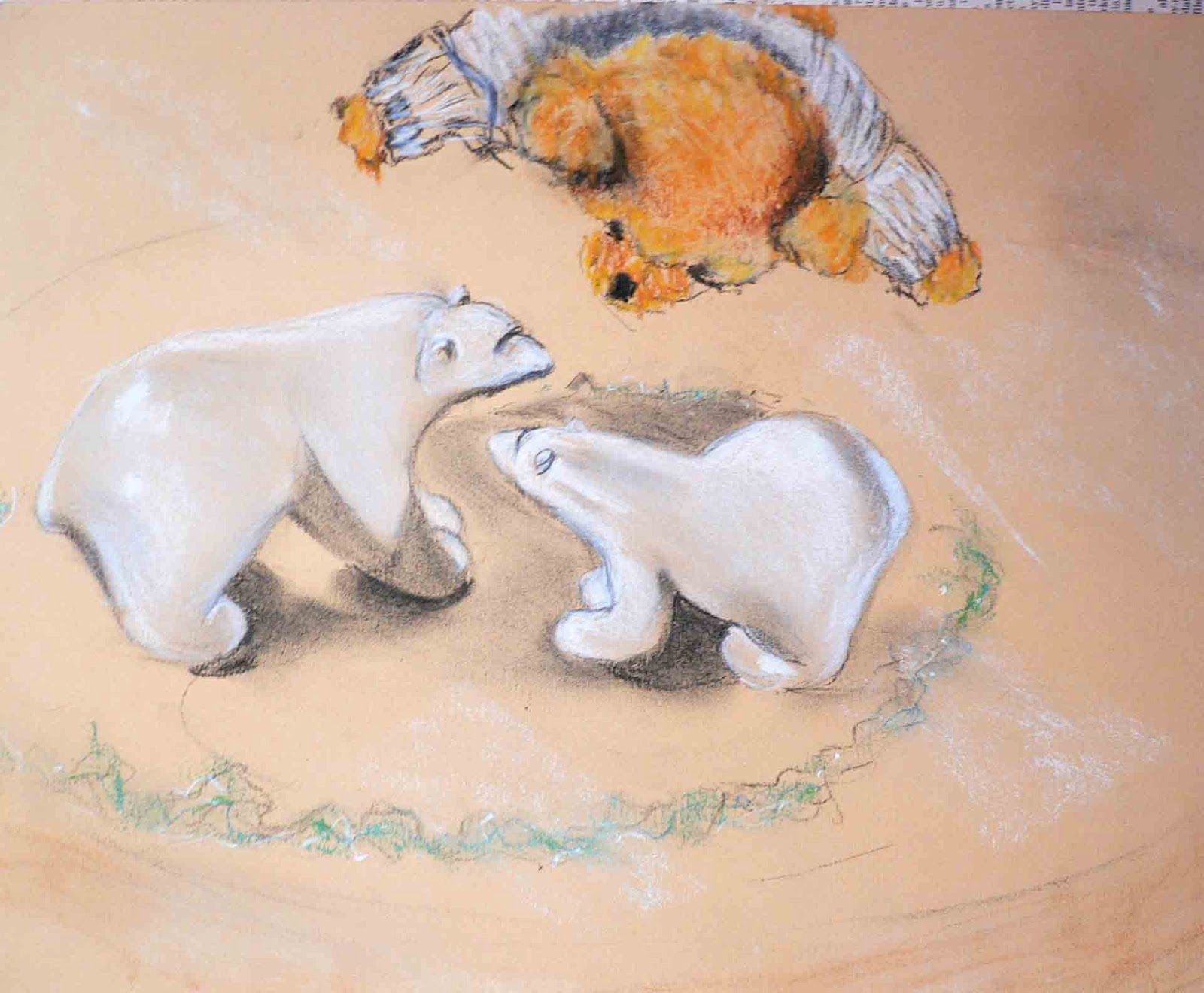
In the basement there are two white marble bears, the gift of the Chief Justice of Canada, set under a glass table-top. They are a source of atavistic confusion to the Supreme Court's souvenir bear who peers in from above.

Then, in full sight of The Queen, he decides to cover everything with billows of white.


Wednesday, 10 April 2013

Supreme Court art: service and the eyes of a child

Today's case is about finding the right address. Talking of which, cabbies tend not to know where the Supreme Court is - the building was Middlesex Guildhall when most of them did the knowledge. This morning I'm offered the House of Lords.

Abela and others v Baadarani concerns the service of a claim form - but, to quote my favourite Rodgers and Hart song, Where or When?

There have been livelier sessions. Counsel are yomping through treacle. In the public seats, some people resort to furtive (forbidden) mobile phone action. To ward off a rumbling stomach, the man next to me eats an inch of cereal bar.

How long is too long? What is 'good' in the sense of 'in good time'?  There's never enough time in court to draw. I'm absorbed like a child. Sometimes I feel a bit swoony. I think I'm forgetting to breathe.
Lunch in the café is a prawn mayonnaise sandwich and, at 79p, the most expensive Wispa I've ever eaten.

The courtroom layout carves the personnel into four slices: public; legal teams; judges; court staff and judicial assistants. I try to represent the different strata as transparencies or ectoplasm.

I think of  Barocci's The Last Supper (below) where the four strata are servants, disciples (outer layer), top tier at the table, angels.

Yesterday, Lord Justice Hughes and Lord Justice Toulson were sworn in. Their families watched from the public seats. I watched on Sky. To end the formalities, Lord Neuberger said he hoped that the conduct of the new justices would be as exemplary as that of their grandchildren.

'The Last Supper' by Barocci


Towards the end of today's proceedings, a family comes in to watch. The little girl is a dead ringer for John Everett Millais's daughter Effie, his model for My First Sermon and My Second Sermon (both below).

More pictures if you scroll down.

Looking out of the window


Saturday, 23 March 2013

Occupy: dreadgate

Tom (left) is refused permission to speak further
Inside the Royal Festival Hall the Philharmonia plays Charlie Chaplin's music to his 1936 film Modern Times, a satire on the Great Depression.

Outside the auditorium, Occupy is having a meeting. Activism and satire are an awkward mix. They create conflict in the soul of Johnny Teatent, aka Tom.


In the squat
From Tom's belt dangles a white man's dreadlock - the only one the man possessed. It is long, springy and shiny. It gives Tom a faint air of My Little Pony back to front. It is described as a scalp, a body part.

What follows is comic and tragic. The glaring need for professional intervention gets lost in a thicket of bureaucracy and self-congratulatory meeting-itis. The victim has asked me to cut what happened. (I suggest he goes to the police, but then I'm a taxpayer.)

Some people leave the meeting in a sweary flurry. Chaplin's sentimental music swells.

Next, the squat pub quiz.


The quiz is at Eileen House, Elephant and Castle, a brutal architectural disaster and subject of an eternal planning dispute. I am accused of seeking glamour in going to the squat. I wish.

'Is the asbestos on this floor?' says someone. Shrug. There is bright cheerless office lighting, a room full of bikes, grey everywhere, a couple of friendly dogs.

My friend Orlando goes to buy himself some tobacco. He comes back. He's left the tobacco in the shop. He goes back for it. Orlando and Tom are probably cool but I don't have a cool gauge. Tom has front teeth missing - knocked out by police, he claims.

Tom, Orlando and I are a team, the Radical Quiz Faction. The questions are monotonous.

'What does LASPO stand for?'
'Name two open-air squats in London.'