 Protecting a mirrored occasional table from my drawing materials. More on the other side: http://boulevardisme.blogspot.co.uk/2013/03/the-bracelet-to-julia-by-robert-herrick.html
Saturday, 30 March 2013
Uses for the Financial Times, part 2
Protecting a mirrored occasional table from my drawing materials. More on the other side: http://boulevardisme.blogspot.co.uk/2013/03/the-bracelet-to-julia-by-robert-herrick.html

Saturday, 23 March 2013
Occupy: dreadgate
 |
| Tom (left) is refused permission to speak further |
Outside the auditorium, Occupy is having a meeting. Activism and satire are an awkward mix. They create conflict in the soul of Johnny Teatent, aka Tom.
 |
| In the squat |
What follows is comic and tragic. The glaring need for professional intervention gets lost in a thicket of bureaucracy and self-congratulatory meeting-itis. The victim has asked me to cut what happened. (I suggest he goes to the police, but then I'm a taxpayer.)
Some people leave the meeting in a sweary flurry. Chaplin's sentimental music swells.
Next, the squat pub quiz.
 The quiz is at Eileen House, Elephant and Castle, a brutal architectural disaster and subject of an eternal planning dispute. I am accused of seeking glamour in going to the squat. I wish.
'Is the asbestos on this floor?' says someone. Shrug. There is bright cheerless office lighting, a room full of bikes, grey everywhere, a couple of friendly dogs.
My friend Orlando goes to buy himself some tobacco. He comes back. He's left the tobacco in the shop. He goes back for it. Orlando and Tom are probably cool but I don't have a cool gauge. Tom has front teeth missing - knocked out by police, he claims.
Tom, Orlando and I are a team, the Radical Quiz Faction. The questions are monotonous.
'What does LASPO stand for?'
'Name two open-air squats in London.'
Thursday, 21 March 2013
Supreme Court: Bank Mellat and Richard III

I'm holding charcoal. That's one thing the planet wouldn't be short of after the bomb.
 |
| Observers in the public seats |
It's a rare day for forensic twitchers: nine judges are sitting, the maximum. Five is routine here.

Counsel: 'The judgment which I have struggled to explain...'
Lady Hale: 'Do you mean that ironically?'
Counsel changes gear politely.
Lady Hale: 'Why do you say it's only a small point? It was virtually the whole submission in the Belmarsh case.'
Counsel changes it to a short point.
'In what sense is this legislation, that is, lawmaking? Is it not more akin to a private Act of Parliament?...This is not an ordinary statutory instrument. I just toss that out.'
 |
| Lady Hale with judicial assistants behind her |
Counsel will have a look at that overnight.
'My lords and lady,' says counsel, 'can I bring in the question of anxious scrutiny?' Anxious scrutiny is what I'm all about here, I think.
 The court has to deal with persistent bundle malfunction. And what a bundle. 'Looking at page 6000...'
 |
| Students in the public seats |
An incongruous sound: a baby is crying offstage.
 There is analysis of whether a party was, in legal terms, an unwitting or unwilling actor. I look around the court as I try to think of an example.
I see Richard III carved into an oak bench, his image copied from the version in the National Portrait Gallery. Was his involvement (if any) in the death of the princes in the tower witting or unwitting? And are those car-park bones his beyond reasonable doubt? Leaving aside some apparent national emotional need, would the skeleton stand up, so to speak, if subjected to the rigorous standards of this court? I don't think so.

Coda: this is a report of 20 March 2013. On 21 March the court sits in secret session for part of the time.
Tuesday, 5 March 2013
Supreme Court art: 'Bunnies can and will go to France.'

As we go down the rabbit hole, that line about bunnies pops into my head. The former Liberal Party leader Jeremy Thorpe was alleged to have written it to an ex-lover and blackmailer, implying that a good job in France could be found to mollify him. The chief victim was Rinka, a Great Dane, who was shot dead. The case went to the Old Bailey.
But I digress. Today I want to show you somewhere more elevated, the Cour de cassation, which is the Paris equivalent of the Supreme Court, but the closest I'm allowed to get is the door [right].
It's Paris fashion week so I'm forced to observe that the Cour de cassation logo, with one C reversing into the other, resembles that of Chanel.

The first shock is the sight of the leading judge's bare forearm beneath his robe.

The territory of the accused is separated from the rest of the court by bullet-proof glass. Papers are passed between narrow gaps in the glass panels. Gendarmes move freely around the courtroom and their guns make my tender English soul recoil.

When the judges start deliberating, I have to leave.

I go to the vast Salle des pas-perdus, a
dimly lit marble loitering area. It contains two unnamed sculptures of lawyers
who should each have a caption on the wall.
A monument to Chrétien-Guillaume de Lamoignon de Malesherbes (1721–94), premier président, inevitably represents the right to advocacy. He came out of honourable retirement to defend the most hopeless client of all time, Louis XVI, and as a result was guillotined, together with his family.
Jean-Étienne-Marie
Portalis (1746–1807) could indeed throw the book at you, as he wrote much of
it: the Code Civil, which the courts in the Palais de justice work to uphold.
 Back in London, I pop into the Supreme Court for a special on-location
recording of BBC Radio 4's Law in Action: Joshua Rozenberg is interviewing Lord
Neuberger, with Shami Chakrabarti of Liberty in the audience.
Back in London, I pop into the Supreme Court for a special on-location
recording of BBC Radio 4's Law in Action: Joshua Rozenberg is interviewing Lord
Neuberger, with Shami Chakrabarti of Liberty in the audience.
Openness prevails.
 |
| Malesherbes |
 |
| Portalis |

 |
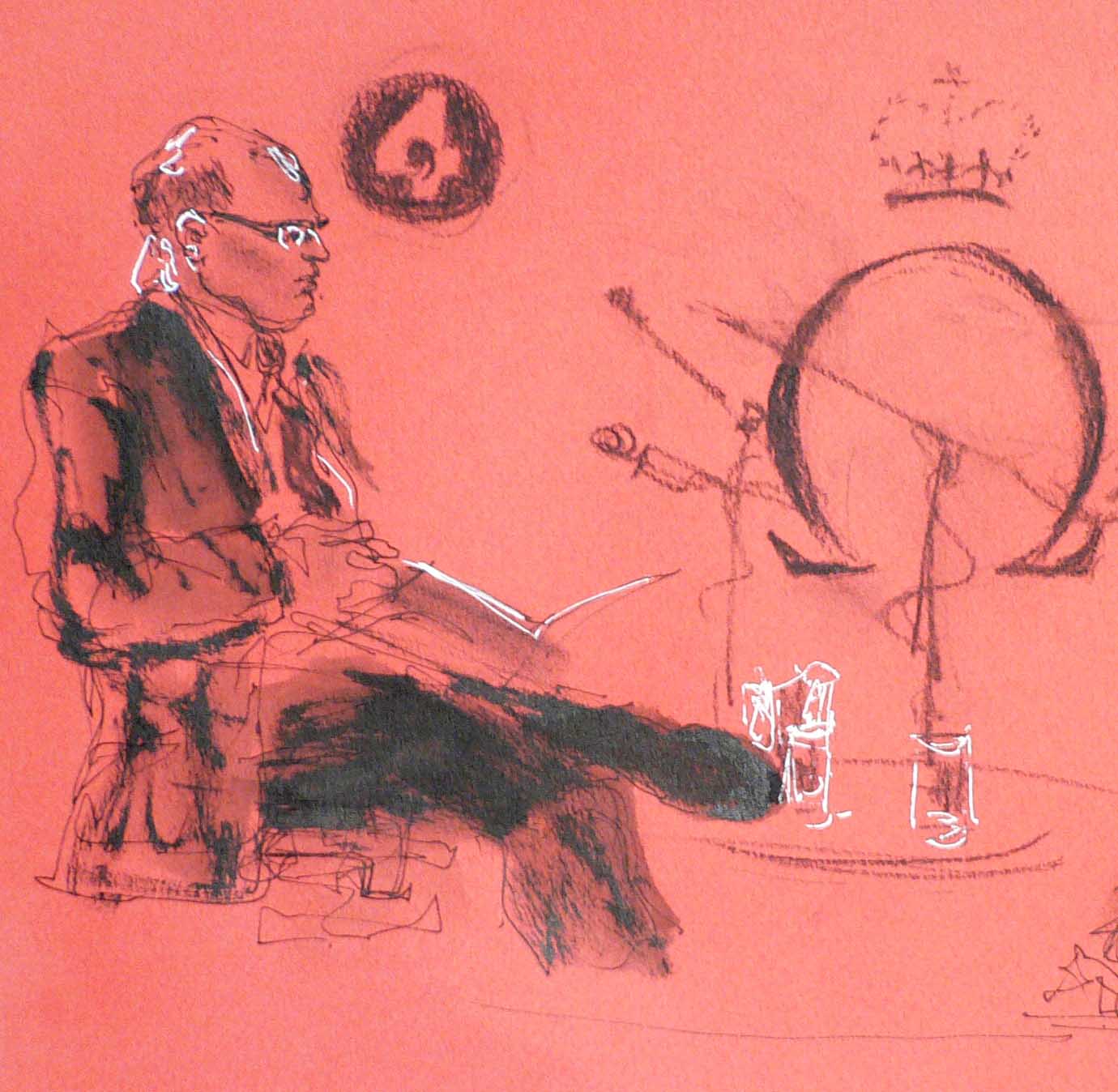
| BBC technician |
Openness prevails.
 |
| Joshua Rozenberg |
Sunday, 24 February 2013
Uses for the Financial Times
It's good for checking I'm in focus. Hmn. More drawings and observations on the other side:
http://boulevardisme.blogspot.co.uk/2013/02/tongue-tied-japanese-rope-bondage-at.html

http://boulevardisme.blogspot.co.uk/2013/02/tongue-tied-japanese-rope-bondage-at.html

Tuesday, 12 February 2013
Supreme Court art: love, music and copyright

There is a pause. I nod vigorously, and pointlessly, from the public seats.
Public Relations Consultants Association Limited v the Newspaper Licensing Agency and others (aka Meltwater) is being watched like a hawk by press cuttings agencies who feel that copyright laws are limping after new technology. So, are copies created when accessing a web page exempt from copyright protection by virtue of the temporary copies exception under s28A of the Copyright and Data Protection Act ?
 I wonder what the average teen hacker would make of all this.
In the legal seats today there are massed ranks of alert brains. I'm finger-painting with charcoal.

Talking of digital technology, I have a skill which Lord Neuberger doesn't: the dying art of touch-typing which allows your speed to emulate Concorde (which has gone the way of touch-typing). There's nothing perverse about a blank keyboard as far as I'm concerned. But Lord Neuberger's left index finger is elegantly raised, kept out of use, rather than lightly resting on its home key of F from which R, T, G, B and V are within easy reach.
 |
| Henry Carr QC |
It's a slushy time of year. The flowers on the Court 2 curtains offer themselves to view. I buy and then liberate the Supreme Court teddy bear, who in gratitude performs some putto moves around the back view of Robert Howe QC, defending. The bear is heavily influenced by the putti action in Watteau's Le pèlerinage à l'île de Cythère (see further down).

Drifting to another fraught copyright area, my weekly YouTube recommendations come in via email. Top of the list this week is Judicial Committee of the Privy Council Judgment 7 February 2013.
Then I'm offered:
The Drifters - Stand By Me
Eric Whiteacre's Virtual Choir - Lux Aurumque
Petula Clark - I Couldn't Live Without Your Love
The Girl Effect - The Clock is Ticking
Edita Gruberova - The Art of Bel Canto
 |
| Le Pèlerinage à l'île de Cythère by Watteau |
 |
| Putti in close-up |
 |
| Edward VII in the canteen |
 |
| Detail from the Court 2 curtains, loosely interpreted |
Wednesday, 6 February 2013
Catullus textual criticism class, Wadham College, Oxford

I email Professor Stephen Harrison. May I come to the class, as a long-ago graduate of this establishment?
 |
A stream of scholars from the Middle Ages to today (ooh look, there’s A. E. Housman) have been wrestling with a variety of transcribers and opinionated editors on the quest for a true text.
One.
The works of Catullus survived through one incomplete manuscript, shot with mistakes (not his), now lost.
 |
This class is wonderful. Two top geezers conduct it in stereo: Stephen Harrison - I haven’t captured his exquisite gestures here but he subtly hand-jives fragments of the poems - and Stephen Heyworth.
 |
I don’t believe in translation. I don’t even believe in synonym. That’s tough.
Today, Tristan Franklinos contributes a scholarly canter through the variants in 69.
Something cataclysmic has happened since I was last in these parts: Sir Tim Berners-Lee.
Would Catullus have used this word? Word search. Click. It’s there. Hang on a second - Plautus used it twice.
It feels like cheating.
When I arrived at university as an ineducable teenager my motto was from Richard II: ‘I wasted time and now doth time waste me.’ In my adult years it’s ‘Otium Catulle’ from a section of poem 51 which he may or may not have written. And what is otium? Time on your hands, freedom, leisure, idling, slacking, messing around, not having to fight a war (and was that considered a good or a bad thing?), Catullus… It’s bad for you… Destructive…
When I arrived at university as an ineducable teenager my motto was from Richard II: ‘I wasted time and now doth time waste me.’ In my adult years it’s ‘Otium Catulle’ from a section of poem 51 which he may or may not have written. And what is otium? Time on your hands, freedom, leisure, idling, slacking, messing around, not having to fight a war (and was that considered a good or a bad thing?), Catullus… It’s bad for you… Destructive…
 |
| I got Argos to make the necklace. |
Subscribe to:
Posts (Atom)