Thursday, 22 November 2018

Read Not Dead: proving that old plays aren't basket cases

Here are some Brexit campaigners with a hamper of tombola prizes designed to show Michel Barnier that the UK is primed to dominate world markets. Co-opted to their cause is Shakespeare, who plundered European sources for a living. Post-Brexit, Shakespeare will still be exploited for national morale and soft power, despite the damage which a dented economy and lack of free movement will do to the arts in the UK. 

At least Shakespeare doesn't have to carry the whole weight of Brexiters' expectations: he didn't work in a vacuum. For example, doomed resentment, so palpable in the photograph above, drives the anti-hero of The Tragedy of Sir John Van Olden Barnavelt by John Fletcher and Philip Massinger. Performed on 18 November in the Sam Wanamaker Playhouse, this is one of some 400 early modern plays which Shakespeare's Globe's Read Not Dead team brings to life. 

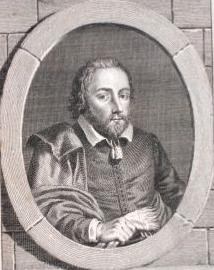
Philip Massinger
With minimal preparation the uncut plays are performed script-in-hand. There are laughs but, for anyone who saw Peter Brook's 1970 RSC white box production of A Midsummer Night's Dream, the raw exposure of the Read Not Dead experience evokes his interpretation of the rude mechanicals' play-within-the-play: this was not the usual Carry-On diversion but a devotional uncovering of the mystery of performance.

Meanwhile the A4 printed scripts take on a life of their own. Can you memorise the odd line and look up - a risk which Tim Frances, triumphant in the title role, got away with? And what about props? With all the page-turning, you can end up waving a pistol like a biro in your spare hand. 

John Fletcher
But when Oliver Senton as Leidenberch, kneeling at the front of the stage, read out his final speech while stabbing himself with a dagger, it was too real for me to watch, and not just because of his performance: there was something terrifying about the script on the floor in front of him, a metaphor for compulsion and inevitability. 

The absence of stage blood - the obvious artifice of which cauterises emotion, to my mind - was another dramatic advantage. (Don't tell me, some people faint at the sight of the fake stuff, I know.) 

I was however able to watch the stylised, slow-motion beheading (for treason) of Sir John: the sword, safely away from his bowed head, preserved tension while severing his connection with the audience so that he could leave the stage, job done.

Portrait by Michiel Jansz van Mierevelt
The Dutch statesman Johan van Oldenbarnevelt was an historic figure. His nemesis, the Prince of Orange, was played with smooth authority by Alan Cox in this reading. Political and religious intrigues in this hastily-written play echoed divisions at home, so the work was censored before its first performance in 1619, the year of Johan's execution. This revival, directed by James Wallace and including Dan Abelson, James Askill, Rhys Bevan, Adam Cunis, Emma Denly, Georgia Frost, Frances Marshall, David Meyer, Mark Oosterveen, Mark Springer, James Thorne and Leo Wan, was the last in Read Not Dead's season about censorship.

For an image to represent the canon of early modern plays waiting to be aired, I give you the chewing gum patches on the Millennium Bridge outside the Globe. These are regularly embellished by Ben Wilson, the Chewing Gum Artist. As one painted patch fades with the passage of years and footprints, he illuminates another, depicting lives of passers-by from around the world. If you see Ben at work, talk to him for the sake of his humane philosophy.


Monday, 29 October 2018

Pro-amdram at Gray's Inn

The interval
The poet Ruth Padel, allowed to study one of Beethoven's manuscripts, kissed it when the curator wasn't looking. This self-dramatising act of microbial vandalism is enough to make archivists faint, even if she wasn't wearing lipstick. By contrast, the Globe Theatre is more positively engaged in an archival kiss of life: its Read Not Dead programme resuscitates the 400-odd early modern plays languishing in the attic.

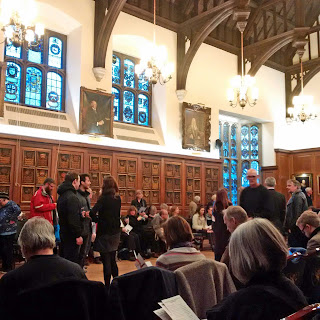
The simplest way to unleash these is to have a script-in-hand, wear-your-own-clothes, move-dynamically-around-the-space-not-bumping-into-each-other reading. Once a year Read Not Dead serves an intriguing cocktail of legal amateur thesps versus real ones in Gray's Inn Hall. This year it was The Little French Lawyer by John Fletcher and Philip Massinger, a polemic against the vice of duelling, directed (briefly) by Nick Hutchison.

John Fletcher
First performed in 1619-23, it has some modern resonances. To start with it is dismally Brexity - dissing the French and other foreigners. In wondering how to treat his wife, a husband points out:
'...I am no Italian
To lock her up; nor would I be a Dutchman,
To have my Wife, my soveraign, to command me...'

It is also very #MeToo, with threats of rape and murder lightly dismissed in a 'happy' ending, and a jolly plot device which allows a strange man to invade the bed of a 16-year-old virgin but that's fine, she's cool with it of course.

Philip Massinger

The attraction of these fleet-footed performances - which have a fiercely loyal following - is that they highlight the actors' skill, vulnerability and risk-taking, without the distractions (which can be ponderous) of costume, lighting, sets, music, make-up, props and, most importantly, the inescapable clamp of the director's world view which may or may not be to your liking.

It was not hard to distinguish the actors from the lawyers. Barristers focus on a small audience: the bench and, if present, the jury. Emotion is cauterised by court procedure. They deliver from one spot. Insults exchanged between bench and counsel are normally so subtle as to be imperceptible to the lay person. Melodrama is rare. William Clegg QC may have fallen from his chair in the 'phone hacking trial but that was not grandstanding to the jury. In court, containment has more effect than histrionics - as in the calm, measured presentation of harrowing facts in In the matter of an application by the Northern Ireland Human Rights Commission for Judicial Review about abortion, heard in the UK Supreme Court last year.

The Globe actors provided the superstructure. Philip Bird kept the play together and gave some charm to the psychopathic anti-hero Dinant. Eliza Butterworth was zestful and winning as the heroine, Lamira. William Foote, Emily Houghton, Rosalind Lailey, Charlotte Newton-John, Patrick Osborne, Doug Rao and Jay Varsani made it look easy when it wasn't.

For Gray's Inn, the distinguished Sir Michael Burton, who in addition to his many legal achievements is a grandfather of nine, was dashing and appealing as the loyal Lamira's one-armed, one-legged husband in the May-and-December romance at the centre of the play. This will not resonate with many still living, but something in the timbre of his voice took me back to Toytown on Children's Hour (broadcast on the Home Service) and the character of Mr Growser ('This is disgrrrrrrrraceful - it ought not to be allowed'). Enthusiastic forensic support was provided by Master Roger Eastman, Gillian Geddes, Colin Manning, Josie Teale, and Sandra Villani (of Venters Solicitors).

Presiding over all was a portrait of Lord Atkin, immortalised by Donoghue v Stevenson, a case as dramatic and yet inconclusive (was there a snail in the ginger beer?) as this Jacobean comedy.

Monday, 17 September 2018

Read Not Dead: 'The Queen's Arcadia' returns to Christ Church, Oxford

As cover versions go, Verdi's Falstaff (libretto by Boito) has the edge on Shakespeare's The Merry Wives of Windsor, knocked out to gratify the whim of Queen Elizabeth I. The RSC's current production is indebted to Barbara Windsor, Benny Hill, and the triumph of Essex (not the Earl) on reality TV. The cast go hell for leather and don't bother to mine it for Lear-like pathos. Costumes are a clever blingy mock-Tudor. There is a cute toy dog. I'm pleased to see they are recycling the throne from their last history cycle.

What can Read Not Dead, Globe Education's Leverhulme-funded early-modern resuscitation team, do with a less performable text? Samuel Daniel's The Queen's Arcadia, another play written for royalty (King James I's consort, Queen Anne of Denmark), was first performed in the blurry acoustic of Christ Church hall, Oxford, in 1605.

Think Love Island without the profondeur. There are lovelorn nymphs and shepherds (one suicidal), slick poetry by the yard and a section about the evils of smoking designed to flatter King James I, author of A Counterblaste to Tobacco.

One day you're Dean of Christ Church, next you're so much lumber


On a CPR course I was mortified to break five ribs on the dummy but the trainer shrugged... And Read Not Dead's bone-cracking techniques are what's needed to keep the patient alive. They scamper through the text before the public performance, then they read for their lives, moving as much as they can in limited territory, improvising to get out of scrapes, galvanised by currents of mutual support. Their risk-taking provides the drama when the text sags.

All the cast had the enlivening qualities the loyal Read Not Dead audience expect: I particularly liked David Collins and Colin Blumenau as the 'ancient Arcadians' propping up idealism, John Hopkins and Sid Sagar making the best of the stock 'funny' doctor and lawyer, and Ross O'Donnellan for a breath of fresh air and cute-toy-dog-handling skills as the shepherd Carinus. The programme note makes a brave attempt at spelling dastardly ('darstedly').

Prop dog politely ignores bread on floor
Also in 1605, away from theatricals, seething religious divisions built up to the gunpowder plot. Nowadays the country is riven by the disastrous cult of Brexit. Christ Church has provided more British prime ministers than any other tertiary institution so, in hall, portraits of Eden, Gladstone, Douglas-Home, Lord Salisbury and others too numerous to mention look down on the political shambles. The sunlight hitting the glass over the paintings picks out over-generous traces of cleaning product, perhaps Windolene, applied vigorously by someone right-handed.

Nothing catches my heart more today than seeing shepherd's purse in the pavement opposite Worcester College:


Here's my sheep-crook and my black dog, I give it to you.
Here's my bottle and my budget, I bid it adieu.
Here's my sheep-crook and my black dog, I leave them behind.
Fine laurel, fine floral, you've proved all unkind...
 

- From Sheep-crook and Black Dog, English folk song

Friday, 7 September 2018

Gaveltastic new book

Checking proofs
It's banging! More Hammers than the London Stadium! More gavels than you can shake a stick at!

A relentlessly detailed new book, The Presidents' Hammers by Diego Tonus, considers 'their anthropological, psychoanalytical and socio-political perspectives'. It unravels gavels around the world, including handbag-sized toffee hammers used to smash windows by the Suffragettes. Pope John XXIII was tapped on the skull thrice with a silver hammer to demonstrate that he was dead. And time was when 'lewd women' were not permitted within a gavel's throw (literally) of a masonic lodge.

Electronic image of a gavel's sound
This book also takes a Hegelian look at the absence of the gavel. There is a despairing chapter by Twitter's own @igavels (inappropriategavels on tumblr) about the promiscuous use of gavel imagery in depictions of UK courts, even though judges here don't use gavels.

Trying to prove a negative, the book includes some of my necessarily gavel-free drawings of R (on the application of Miller and another) v Secretary of State for Exiting the European Union, the UK Supreme Court case which determined that Parliament should have a vote on triggering Article 50.

Instead of these drawings I offered to sketch the bench itself to show that no gavel lurks alongside the documents, laptops and, in Scott (FC) v Southern Pacific Mortgages and another, Lady Hale's folkloric embroidered spectacles case*. My offer was politely declined in favour of parading our national humiliation of Brexit.
*Not a gavel
Still, I did suggest what a judge could do with redundant gavels:

For those daydreaming about a special honour - garter stitch
Incidentally, Lord Thankerton, one of the majority in Donoghue v Stevenson, used to knit on the bench, presumably as an aid to concentration. If anyone knows what he knitted, or has a surviving artefact, I would be grateful for information.

For any judge with a thwarted craving for gavel action, this book would surely be a fulfilling gift. Diego Tonus has made authentic replicas of a collection of 53 gavels in the International Institute of Social History in Amsterdam, 'ones that had belonged to revolutionary and emancipatory movements from the 19th century up to recent times'.

There is a touching humanity in Diego's preparatory technical drawings of each gavel and its wounds.The picture here shows impact marks as well:
Copies of The Presidents' Hammers are available here.


Thursday, 30 August 2018

Notting Hill Carnival 2018

I'm with Elimu Carnival Band as they get ready in the Paddington Arts building. This is the first carnival after the death of Annie Curtis Jones, the band's much-loved creative director who designed and produced ingenious costumes on a shoestring.


The youngest masquerader


Artificial ivy trails around the filmy dresses and the skirt hoops are made of hose-piping.


The King before he dons full costume


I'm stalking the moko jumbies, led by Alan Vaughan, who dance on stilts. Sharing this year's Windrush theme, they are performing to the calypso song If You're Brown by Lord Kitchener. More brilliant and painstaking costume design - and there is something heartbreaking about the smart hats and optimistic suitcases of the guests who were invited to help put post-war Britain together again, especially in this ghastly year of Brexit disaster and hostile environments.

During preparations the moko jumbies are as elusive as wild birds: to put their stilts on, they perch out of sight on low roofs and high walls.
Behind giant butterfly wings


I wander out in the afternoon. A doorman on duty outside Beach Blanket Babylon takes a toke on a tube emerging from a reveller's smell-proof bong backpack. 

A kid inside the metal gates of a detached house is selling loo-visits for two quid a time; he probably reads Warren Buffett; there's been a steady queue on the pavement all afternoon.

Elsewhere I see people getting a stiff talking-to from riot police for using front gardens as latrines - when I say people I mean women who, unless they have an appropriate device, are not helped by the provision of extra urinals this year.


Sunday, 22 July 2018

Byfleet Parish Day

I'm trying to forget Brexit but one of the entertainments here is a guitar duo called The Cherry Pickers.


The vast recreation ground is parched and scorching so I leave the stalls, tombolas and raffles, obedient dogs, juvenile dancers, pipers, stunt cyclists, Punch and Judy and all the melting trappings of a successful summer fête. The village hall is cooler and that's where to find the produce and handicrafts.


Janet Hodges's knitted Ross Poldark glowers like the real thing.


The 'four courgettes' class evokes T. S. Eliot