Monday, 19 March 2012

John Cooper QC, leading counsel for Occupy London

‘Many people think that if they’d had a jury they’d have won,’ says John Cooper QC. He was leading counsel for Occupy London in the High Court case brought by the City of London to evict the St Paul’s camp. He also argued in the Court of Appeal for the right to continue the case there.

‘The atmosphere in the courts was great,’ he says. ‘It was very much – not that I was there at the time – the sort of atmosphere you could imagine would’ve filled the revolutionary courts of eighteenth century France but without the violent connotations - packed with different people from Madame Defarge to the aristocrats.

‘Occupy instructed me to put some really good questions to the City and the church. When Nicholas Cottam [the Registrar of St Paul’s Cathedral] was asked, “Are you giving this evidence with the church's blessing?” he said yes. That's always mystified my clients, the church saying that they were neutral and then sending Cottam to give the damning evidence which helped to build the case against Occupy.

‘A lot of the general public were supporters of Occupy. One argument was that schoolchildren were unable to visit the church - whereas a lot of schoolchildren were brought to see Occupy.

‘The dynamics of the whole thing were fascinating, between the church and the state. The irony of ironies was that St Paul was a tentmaker. The occupiers didn't aim for St Paul's in the first place – it was the police who kettled them there. If one believed in such things one could say it was the hand of God – forget Maradona, look at the iconic nature of St Paul's, surviving the Second World War.

‘There were some very quirky moments. On the first day of the High Court hearing a group of Cambridge students passed an academic letter to the judge asking esoteric points of constitutional and ecclesiastical law. And in the Court of Appeal the Master of the Rolls said he’d rather read The Occupied Times than the Daily Mail.

‘I got involved because Duncan Roy, a former pupil here at these chambers [25 Bedford Row], rang me up on 15 October and said, “We're occupying outside St Paul’s and we need some urgent legal help.” When I first took it on there were a couple of people who thought I was some sort of City undercover agent. One of the individuals who challenged me about that had the good grace at the end to apologise.’

The named defendant representing Occupy, Tammy Samede, was originally too shy to speak at meetings. ‘I wondered at one stage whether she was confident enough to get into the witness box,’ says John. ‘But she was very good, particularly in her addresses to the camera, and she’s become very assertive. She’s grown as a human being, quite frankly.’

I (this is your blogger talking) was in the public gallery when Tammy gave evidence. At one point the cleanliness of the camp was at issue, and she was challenged about a hasty clean-up organised when the occupiers discovered that the judge would be visiting.

Tammy replied coolly: ‘I would always clean my house if I was expecting a very important visitor.’

‘I’m very flattered,’ said Mr Justice Lindblom, twinkling behind his specs as the public giggled.

John says: ‘They achieved an awful lot in the High Court and came away with great credit. There was a defined amount of legal material with which to work, but as well as the black letter law argument my clients were interested in raising the principle of the occupation.’ Occupy’s entire legal team was working unpaid.

(Two of the arguments were that the City’s demand for eviction was disproportionate to the effects of the camp, and that the occupiers’ right to a protest site outweighed any need for eviction. Some witnesses wept while giving evidence, one while denouncing global warming as genocide, an issue worth having a protest camp site for.)

John says: ‘The High Court judge and the three judges in the Court of Appeal all commended the integrity and decency of the Occupy clients, which was really important because when it comes to the debate in the future I don't think they're going to have the stigma that was unfairly placed upon them of being loony lefty hippies – not that there's anything wrong with lefty hippies – but it was used as a derogatory term to distance the argument. From now on people are going to have to treat them with respect.

‘It's been a great experience with a group of people from disparate backgrounds – a broad church just as society is. It’ll be interesting to see what happens in May.’

(Events are being planned although John is not privy to that aspect of their work.)

John has just been named as one of The Times’s Top 100 Lawyers: ‘The first I knew of it was being congratulated on Twitter. There are very few genuine surprises left and that was one of them.’


His latest press article is on circus animal welfare in Criminal Law and Justice Weekly @CrimLawJustice: ‘I'm reviewing the law relating to keeping captive wild animals in circuses, commenting that the Government should do what they keep promising to do. That is, ban it. The Government are waiting for a decision in Austria to make sure they’re not going to be sued. Which is disappointing because they won't be. So although Defra are going to issue some licensing procedures, wild animals are still being used in circuses. How long do they have to wait?’

Animals ‘performing’ for human amusement include zebras, lions, snakes, tigers, camels, a kangaroo and a crocodile. John is also the chairman of the League Against Cruel Sports, which campaigned for the hunting ban and helped to draft the Bill.

The conversation drifts. ‘My education was at a comprehensive school. I come from a working class background, so no lawyers in the family, and I was told when I went to the bar in 1983 that “people like you don’t become barristers.” Funnily enough it wasn’t the barristers telling me that. I must say that the bar was very inclusive and supportive, and I’ve recently been made a Master Bencher of the Middle Temple which I’m very proud of. One of my loves in life is history and it’s one of the best inns of court to be involved with for history. Shakespeare set the start of the Wars of the Roses in the garden, and the hall is a fine example of Elizabethan architecture. A table there is made from the wood of the Golden Hind. It was also the setting for the first production of Twelfth Night, in the presence of Shakespeare.'

He reminisces about acting some years ago:

‘Apparently I was a good Iago.

' “Now, by heaven,
My blood begins my safer guides to rule;
And passion, having my best judgment collied,
Assays to lead the way. 'Zounds, if I stir,
Or do but lift this arm, the best of you
Shall sink in my rebuke.”

‘That's Othello speaking – I even learned Othello's lines.’

He studies the drawings. I’ve been talking too much, not concentrating on drawing enough. Still, ‘I love your style with the lines.’

Sunday, 4 March 2012

Occupy London at Finsbury Square - bones and mudslinging

Life class model
I came under attack for writing this particular post, which must now read as follows:

'You've got balls to [censored], ' she [censored] at me, yesterday's make-up scribbling dejection on her face.

It's raining. The Finsbury Square Occupy London camp is a mud bath with a track of slippery decking partly covered in chicken wire. Some of the puddles are filled with shredded Christmas trees.

(The Occupy censor commanded me to delete the previous paragraph, but the meteorological records for London are freely available and I don’t expect you to believe that Stalinist sunbeams dance perpetually on the blithe upturned faces of occupiers.)

She is certain [censored] Twin Towers [censored] myth [censored].

Look, I record. This blog is subtitled 'drawing from an uncomfortable position'.

Here's an example of what I mean. Last week the life-class model apologised before undressing: 'I've been ill and I'm very bony.' My callous eyes lit up. 'Don't diss yourself,' I said. I should have filled her with fish and chips and Guinness but I revelled in the skeletal sight. We purred at her frangible beauty as we drew.

And now I think I've achieved the unthinkable - being told to get the hell out of an all-inclusive Occupy site. Then the Scouser Jimmy, who has slept rough outside St Paul's for the last ten years, assures me that I have some way to go: 'You're always welcome here, Princess.'

There are rumours of imminent eviction even though no formal notice has been served. A black duffel coat lies in the mud. In the crowded kitchen tent, damp Occupiers steam gently, eat curry and watch West Ham in a football tournament sponsored by RBS.

The municipal flower beds commandeered to grow food make me think of anxious, undernourished evacuees. There is no root-room for fruit trees as a multi-storey car park lies under the six feet of soil.

The Occupy guide to management without managers is waiting to be written, starting with the need for nominated press spokesmen. Today's Sunday Times has effected a stitch-up by quoting Occupiers who are decidedly off-message: one says he raises funds and then spends the money on drink and drugs.

Rosa, recovering from viral pneumonia, has a damp tent. I fetch some old copies of the FT from the car to sop up water. I explain to her that I don't feel welcome on site. Oh, I hear someone clomping up the decking to seek me out. The look is minatory. 'I DIDN'T THROW YOU OFF THE SITE, I JUST SAID YOU'VE GOT SOME BALLS TO COME BACK HERE AFTER THE WAY YOU WROTE ABOUT ME.'

I go to St Paul's Cathedral. In the crypt cafe is Gbola, decorating his conversation with snatches of hymns. He needs shelter following last week's eviction of the St Paul's camp. Obi, a gentlemanly Occupier and Star Wars fan with a vast social conscience, is fighting fatigue: he spent last night making sure Gbola was safe, first in an all-night cafe then, from 4am, on the concourse of Liverpool Street Station, among homing clubbers.

Gbola can't sleep at Finsbury Square because his wheelchair will stick in the mud. Canon Mark Oakley and two vergers take up his case; a member of the cathedral staff takes Gbola in a cab to St Martin's in the Fields, by Trafalgar Square, in the hope of finding shelter for him there. I reflect that compassion needs to be dispassionate in order to work.

Nathaniel
I go to Starbucks and draw three children. Their mother,Tammy Samede, found her voice as the named defendant in the High Court eviction trial.
Georgia
Nathaniel gazes at me with the ancient wisdom of childhood. He understands that being a sitter is a job of work and has an unnerving grasp of the collusion between sitter and artist. Unlike many adults he does not look down at my paper: he knows that he, not the picture, is important, because I have to look at him more than I look at the drawing.
Olivia

I drive home. On the car radio a choir sings: 'Keep calm and carry on' from Traditional Values, composed by Orlando Gough with words by Guyanese/British poet John Agard.

Gough tells an interviewer that the work reconsiders a 'warm beer, John Majorish' Britishness, focusing on tea, the weather and cricket. 

He's quoted on the internet: 'The tone is affectionate, ironic and celebratory, and the music is suffused with influences of pop, gospel, reggae, calypso, bhangra and qawwali. What is really being celebrated here, I think, is...stoicism, tolerance, adaptability, irony and...diversity.'

The choir sings:
Certainty can be a curse.
It can lead to bigotry or worse.

Friday, 24 February 2012

Occupy London: the last Thursday at St Paul's


I'm dissed by a man in candy-striped hold-ups and a miniskirt with a fabric flower in his hair as he puts red and blue flashing lights on his head before cycling home: 'You're jealous of Princess Diana because she had something you don't have. Compassion. She cared about everyone. You're just here for your own interests. I showed you my book but you didn't like it.'

Debbie
The camp has shrunk. A patient group of Occupiers cuddle together on the cathedral steps keeping vigil with tea-lights and flowers; someone is intoning into a microphone. They expect eviction any minute.

Debbie works in welfare benefits and is here because of the cuts: 'I've always been protesting - in the late 90s there was Reclaim the Streets, Stop the City. It got violent and that was horrible. My daughter came here first and told me that it was a completely different kind of protest, non-violent.'

Debbie is with the Anonymous group who wear the masks. She dispels my assumption that Anonymous is a blokish hackers' movement: 'I see myself as being a hippy. They're very peaceful, there's a nice vibe about it.

'I've never been drawn before. When we get raided by the bailiffs I'll grab my picture.'

I'm sketching in the cold, by the light of a lamp post, unable to discern colours clearly, at one point being filmed making duff decisions about how to draw by the guy from Channel 4 who's been haunting the camp. I am naked. Yes, her face is narrower, yes, I did eventually notice, come back and film the corrected drawing please.

Jimmy, the gallant Scouser who has slept rough outside the Cathedral for ten years, has filed a legal claim to ownership of St Paul's Cathedral on behalf of the Occupiers.
He's carrying his rolled-up portrait which I drew on 11 December.

E, Occupy's answer to Clint Eastwood, kisses my hand. 'You're a beautiful woman, Isobel.' We are both intoxicated in our different ways.

Tigger
Tigger lay down under a police van during the recent eviction of Occupiers from the Bank of Ideas, the squatted UBS building in Hackney: 'It all kicked off when the bailiff punched two people. It was stressful and I smoked a cigarette under the van. A St John's Ambulance man warned me that I was near something extremely flammable [the petrol tank] but I didn't care. After the building was cleared I gave the bailiffs the run-around.' He managed to get back up onto the roof of the building from the outside: 'There's a little church next door.' He's a  free-runner, using walls and roofs as gym equipment.

'I'm from Hinckley in Leicestershire,' he says. 'I used to work in a hostel for young people with mental health problems but it got shut down by the government. That's why I'm here.'

Two men comment while I'm drawing him: 'Draw the big knob on his forehead. Get a permanent marker, quick. What kind of bell end does he look like?'

Chrissy
Chrissy, from Dusseldorf, was on holiday in New York with two friends when Occupy Wall Street started so they spent time in Zuccotti Park. 'There was a pizza restaurant close by and people from all over the world were contacting it to order pizzas for us. They made a special Occupy pizza - a big one, with meat. There were lots of pizza packets on the site, used to make signs.'

She's with Occupy in London for the duration: 'I'm a media analyst so I can work anywhere freelance. All I need is a laptop and a signal.'

Charlie
I'm struggling to find enough dregs of observation to rescue my drawings, too tired to talk properly to my sitters. The Che-lookalike, Charlie, is a Sinhalese Sri Lankan. He works in the tranquillity (euphemism for security) team. There's a red cardboard heart pinned to the tree trunk behind him.
Michelle

Ye Olde London on Ludgate Hill is shut so for the first time I'm going to have to use one of the camp's portaloos. Michelle mimes how to make a Z-shape so that no part of you ever touches any part of the interior of the portaloo. She kindly stands outside because I am claustrophobic and don't want to lock myself into this imagined hell. But it turns out to be a banal experience.

Obi
There is even a supply of loo-paper thanks to the vigilance of Obi, a purposeful and quietly motivated presence in the camp.

It's 1am. My observation is such that I have parked in a disabled parking space without noticing either the road marking or the yellow sign on a pole by the space. I await a letter from the City of London Police.

Monday, 13 February 2012

Not the last Sunday for Occupy London at St Paul's


'Jesus said before he went, "Have love among yourselves," ' says Tammy Samede. She is the named defendant, representing the Occupy camp at St Paul's in the eviction trial. 'I love Occupy. Here there is honest to God straightforward love for each other. I don't need anything while I'm here and there are hugs everywhere. I've got a few changes of clothes and a couple of books but I'm happier in 33 years than I ever was before.'

She feels that the cathedral has given Occupy a mixed response: 'Sing like an angel and act like a demon.'

'My benefits have been stopped because I'm not seeking work that the government thinks I should doing instead of  trying to change the world. My flat's being repossessed. It's too late to change that now.We're not going to stop when the tents have gone. It's just going to get more and more amazing. It's a scary moment, losing my flat and stuff. But I don't deal with sacrifices. It's the right thing to do. My belief is that the universe provides and it sure did.' 

Tammy was pragmatic about legal costs: 'I thought, I ain't got nothing. They can have a pound a week off me for the rest of my life and I'll have a long and meaningful relationship with the City of London.' In the event, the Corporation has waived costs against her.

'Occupy is about hope, it's about change, it's about people getting together,' says Tammy. 'All different kinds of people. Like Giles Fraser. Where else in life would I become friends with a canon of St Paul's? And they say the homeless services aren't able to cope. We've fed 'em. We've managed. I get angry about it.'  

Formerly inhibited, Tammy has grown into a fierce public speaker and in court I saw her earn the judge's respect for her confidence under cross-examination.

Tammy recently embarked on treatment for post-traumatic stress disorder, caused by her troubled childhood. After seeing her poised performance on TV, one of her counsellors called her to say that further treatment wasn't necessary. (I am naturally wary of long-distance assessment.) 

'Our brothers and sisters in Syria - they walk into the bullets.' says Tammy.That's how strong their desire is to change things. Here we are squabbling about a few tents.' 

Tanya Paton, a catholic working on Occupy's 'multi-faith, believer and none' working group, charmed half a dozen free Portaloos out of suppliers and is arranging for them to be restored to their owners before the anticipated eviction. The cleaning is not free and has been a big part of the camp's budget. 

Tanya is working on plans which include an interfaith Occupy pilgrimage to Canterbury in June. Her daughter Skye is a serious, happy eight-year-old whose rabbit is called Pebbles. 


Back in the long-running sitcom which is the info tent, Lee studies his portrait: 'I look like a commissar.' He kindly gives me a SACK BORIS Oyster card holder produced by the Transport Salaried Staffs' Association. 

Lee is a legal observer at demonstrations and a children's entomological entertainer: 'I take giant spiders and cockroaches into schools - The Big Bugs Show. We have cockroach racing and sometimes the kids eat bugs from Fortnum & Mason. The spiders are called Barbie, Hayley and Cayley - nice girlie names. A giant spider's feet feels like a hamster on your hand, or the paws of a kitten. It helps kids to feel good about science.'

'Can I find you online?
'Someone's stolen my website,' he fumes.

Constable 673 has never been drawn on duty before: 'It's amazing!' I've done a too-hasty sketch: she was standing in front of a bare light bulb so I couldn't see her clearly but my street rule is to be a passive instrument and draw whatever's in front of me without manipulation.

She is not permitted to accept the picture, as my other street sitters do, or to be photographed with it while on duty. 


She turns politely to a woman with a dog off a lead. 'You know what I'm going to say,' she says, with quiet charm and instant effect.


I pop into the kitchen tent. Music blares from a laptop: You blocked me on Facebook. And now you are going to die. Lilias, a relative of H. Rider Haggard, who wrote King Solomon's Mines, is doing a limb-thrusting-out dance to keep warm. 'You should go up Ilford on a Friday night,' says Tigger, a female kitchen helper. A man carrying a red rose comes into the kitchen tent, smoking. 

'You always break the laws of the kitchen,' sighs Mohammed. 'Please smoke outside.'
'And shove that rose up your arse,' says Tigger.
A man looks dubiously into a mug of pale coffee he has just made: 'There's something missing. I don't know what.'
Reuben [left]

I sit in on a general assembly - one of the amorphous meetings, open to anyone, which aim to produce consensus for the leaderless patchwork movement.

I sketch in the icy tent, my clockwork running down, and the talk is like a baroque opera: exposition, development, a return to the beginning, polite groans at the repetition... But the facilitator, Tina, grabs the sense and propels the makeshift orchestra to a conclusion.

I'm giving a lift home to Liz Beech, a Greenham veteran. She's lugging her portable manual typewriter, the vessel for visitors' comments over the past four months. The Museum of London want it, but she's keeping it.


I've been coveting the badges and in return for a sketch Reuben, with white beard and black fur hat, gallantly procures one for me: I leave camp with a hug and a kiss.


Wednesday, 8 February 2012

The case of the high profile


Michael Paget is one of the barristers representing Tammy Samede, the named defendant who stands for the Occupy camp at St Paul's like a tiger mother.
He muses: 'I've got several artists in the family...'

My heart leaps: 'SIDNEY PAGET?!'

'Yes.'

No shit! Sherlock! 

Kind of.

I say: 'Show me your profile.'

I get a bit gibbery. Any chance of my doing a half-decent sketch flies out of the window, along with my concentration.

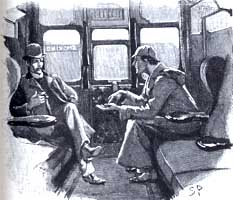
Michael is the great-grandson of Sidney Paget who illustrated Conan Doyle's stories when they first appeared in the Strand Magazine (and added the deerstalker). We had bound copies at home and as a child I was transfixed by Paget's drawings. The model for Holmes was Sidney's younger brother Walter, who bequeathed his elongated, elegant profile to the iconography which led to Basil Rathbone and Jeremy Brett.

Sidney Paget drawing of Sherlock Holmes and Dr. Watson in Silver Blaze'I'm  more like my mother, who's also an artist,' says Michael, but the ghost of the profile is there.

Photograph of Sidney Paget, dressed in a suit and looking to his right
Sidney Paget
The observant ghost of Sidney is present too, so from under the rubble of my confidence I do two rubbish drawings. A sense of history is a burdensome thing.

Michael, who is at Garden Court Chambers and has the Victoria Climbié inquiry and Dale Farm on his CV, is also representing the Sheffield Occupiers: ‘I hope the Master of the Rolls gives the appeals a fair hearing. It's been a privilege to work for Tammy and Occupy. And the full court room has been in complete contrast to my usual cases, where the audience is one opponent (very bored) and one judge (often asleep).'


Sunday, 29 January 2012

St Paul's - not the last Saturday of Occupy London

'I'd like the word "bonus" to be removed from the Oxford Dictionary,' declaims Father Joe Ryan, to cheers from the crowded steps of  St Paul's. Steady on, people, I think. It's not the word's fault.

Then a rock group makes distorted agitprop noise which cannot be escaped. A female cleric, iron with purpose, swoops down from the cathedral to say this is a public nuisance then floats back up the steps on a cloud of fury. She has long straight blonde hair. Her floor-length black clerical gown is close-fitting to the waist then billows like the most magnificent ball gown behind her as she ascends, unimaginable yards of cloth.

The next speaker is the Rev Paul Nicolson, chairman of Z2K, a charity which guides vulnerable people in debt. The last paragraph of his speech is: 'The poorest and the squeezed middle should unite in protest and justified moral outrage at the injustice of a deficit reduction policy which hits them hard and the richest not at all. In my view that is an outrageous injustice. It fully justifies non-violent civil disobedience. But I worry constantly about it turning violent, hoping and praying that it will not.'

He refused to pay the poll tax because he believed it was an injustice to the poorest people, but it was docked from his pay anyway. 'I told the Church Commissioners they should be involved in civil disobedience like I was. I got a very short answer.'

Before becoming a vicar Paul worked in the family Champagne business. He recalls a two-week trip to Paris learning how to sell Champagne to nightclubs: 'I went to one club where there was a bottle of Veuve Clicquot on each table before you sat down. Mistinguett, the Folies Bergere star, was sitting at a table. Her legs had been insured for £1,000,000 because they were so beautiful. By then she was 86. A female impersonator did his impression of her while she sat holding hands with a dwarf. Then Jacques Tati walked in and sat at the bar. It was pure Toulouse Lautrec.'

Juliane, from Essen in Germany, is a member of Occupy's economics working group. She did her doctorate at Cambridge on how initiatives such as the Fairtrade movement bring about social change, and is now assistant professor in organisational behaviour, teaching business ethics at Warwick Business School, Warwick University.


Joey was born in Lincolnshire. He had been travelling around last summer litter-picking at festivals, came to London to join Occupy, and is in charge of the recycling bins, the dustbins and cleaning the Portaloos. The camp has to have a Swiftian obsession with what it discharges.

The mood is nostalgic, subdued; the wind is cold. Each gust makes the small tents strain from their moorings.

I go to have tea with a friend whose parents had been imprisoned for anti-Apartheid activities.

Sunday, 22 January 2012

Occupy London at St Paul's - another Sunday


We gather round creamy-skinned national treasure Dame Vivienne Westwood in the chilly university tent. 'Artists are freedom fighters,' she says. 'Go to the National Gallery and start with the seventeenth century Dutch paintings. I don't like installations. It takes no talent to make them.' Liz, the Greenham Common veteran, weighs in on behalf of installations. A man asks if Vivienne will take a group of people round the National Gallery because he doesn't know what to look at.

I tell her afterwards that I used to wear one of her bustles and people would forever whisper to me that I had my skirt caught up in my knickers.

I try to hand the picture to someone who I think is a member of her team.
I ask: 'Are you in her entourage?'
'Her WHAT?' she blazes at me, with a scowl.
She is.

George
George Barda is one of the litigants in person fighting eviction from St Paul's. He wept in the witness box, glimpsing the magnitude of his campaigns. The judge complimented the defendants' 'passion and sincerity'. In contempt of court, someone had posted an illicit courtroom photo of George's left ear on Facebook last time I looked.

I draw Peter Olive. No time to chat. He is a writer/producer/multi-instrumentalist/DJ.

Online I find a photo captioned: 'Peter Olive played keyboards in the debut performance of Adam Ant's Pirate Metal Extravaganza at The Scala.' 


Barry is playing a 1979 Fender. Knock knock knocking on heaven's door, Ziggy plays guitar.  I ask why he's playing music from before he was born. 'I like 70s music - glam rock, ska, new romantics. I come here a lot, not so much for the politics but for the jamming and the music. There's something every day. It's better in the warm though. I'm off to the Bank of Ideas.'
Barry


Erin is flopped on a sofa in the library tent. We are accompanied by a Diana superfan who spent each day of her six-month inquest in court, with DIANA and DODI written on his brow. He stands holding heavy orange carrier-bags which he doesn't put down. 'Were you at the royal wedding?' he asks me.

Erin puts on a pale lilac flower and a purple polka-dot ribbon for the picture.
'I've just been asked to model underwear.'
'What label?' I ask.
'Occupy. Underpants.'

Erin has recorded songs, playing the piano accompaniment as well. I listen to the cassette through earplugs: melancholy, sweet.

Erin hands me a booklet: 'Some Very Nice Songs' by Joe Nobody (i.e Erin):
Tear out the page from my daydreamer's book
Start out a new one, p'raps this time a true one.
Erin
On my first visit to the camp, someone told me to go down to the library. I looked beyond the tents for a public building. Mistake. You have to adjust your idea of scale. It's a bit like The Borrowers.

At that time the library was a couple of shelves of paperbacks in the open air. Now it's a tented retreat with squashy chairs, clapped-out sofas, an atmosphere and a mild-mannered librarian, Nathan from Pollok in Texas. Somewhere to get sentimental about as it recedes into history.